I never thought I could make nougat at home until I visited a candy shop in Italy and watched the candy maker whip it up before my eyes. The process looked like magic—sugar syrup poured into whipped egg whites, transformed into a fluffy, glossy mixture studded with toasted almonds and pistachios. When I returned home, I became obsessed with recreating it. After several attempts, I finally nailed this nougat recipe that produces authentic, chewy candy just like I had in that Italian shop. Now I make it every Christmas, and people can’t believe it’s homemade. The satisfaction of creating this seemingly complicated confection is absolutely worth the effort.
Why You’ll Love This Nougat Recipe
This nougat recipe creates authentic Italian-style candy with a chewy, slightly sticky texture and wonderful nutty flavor that tastes nothing like commercial candy bars. You control every ingredient, meaning real honey, quality nuts, and no artificial additives or preservatives. The recipe is surprisingly approachable once you understand candy-making basics—you just need a candy thermometer and attention to detail. Making your own nougat costs a fraction of what you’d pay for quality artisan candy, and you can customize the nuts and flavorings to your preference. The finished candy makes impressive homemade gifts when wrapped beautifully in parchment and tied with ribbon. It’s naturally gluten-free and can be made with various nuts or even dried fruit. Best of all, the texture and flavor are far superior to anything store-bought—chewy without being tough, sweet without being cloying, with toasted nuts adding perfect crunch.
What Is Nougat?
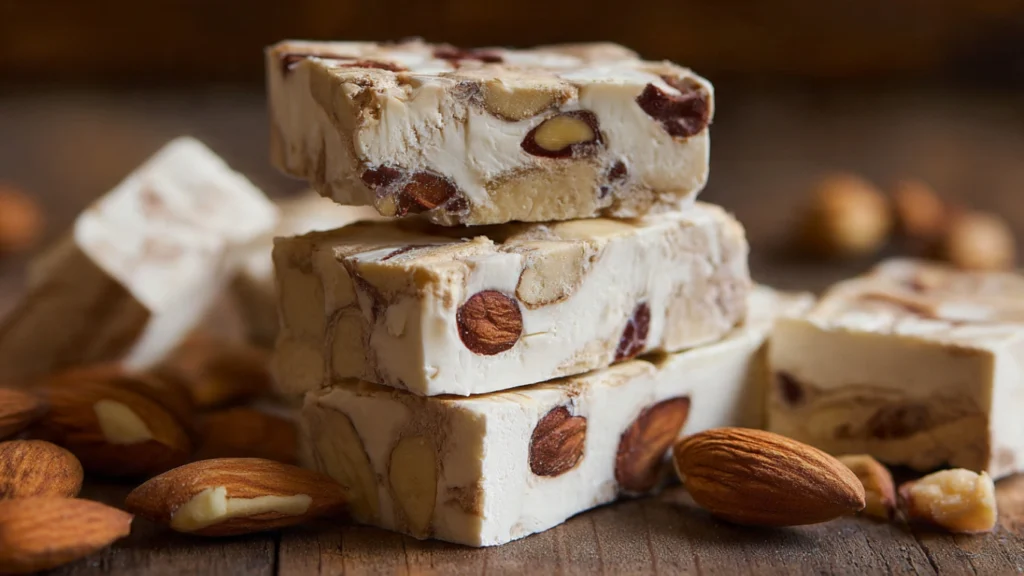
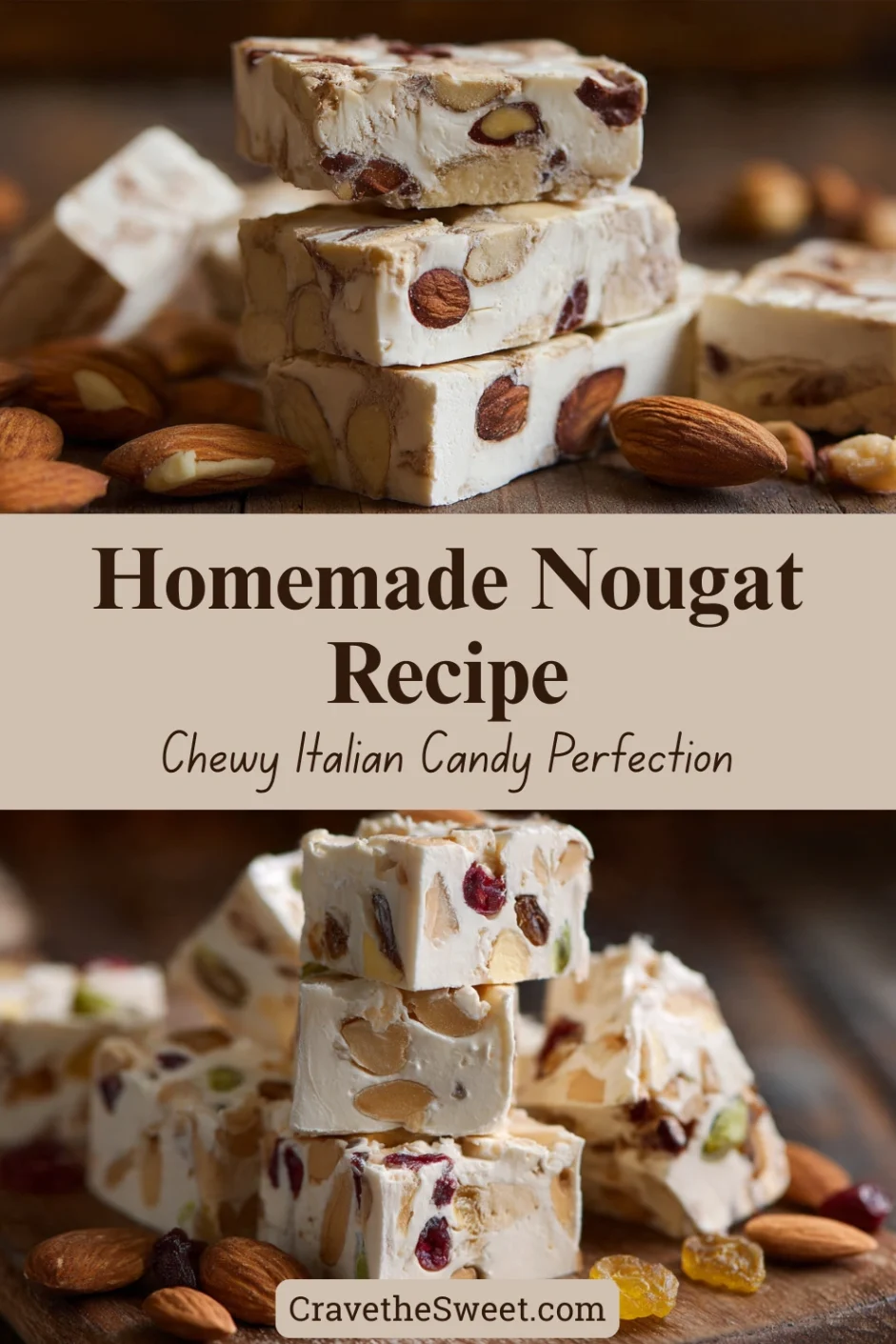
Nougat is a confection made from whipped egg whites, sugar, honey, and roasted nuts, creating a chewy, airy candy with distinctive texture and nutty sweetness. This nougat recipe produces Italian-style torrone, the authentic version that’s much softer and chewier than the hard nougat found in candy bars. The candy has ancient origins in Mediterranean cultures, particularly Italy, France, and Spain, where it’s traditionally made for holidays and celebrations. The base is essentially a cooked meringue—egg whites whipped until fluffy, then stabilized with hot sugar syrup. Honey adds flavor and helps create the characteristic chew, while toasted nuts provide textural contrast and rich flavor. Good nougat should be chewy but not stick to your teeth, sweet but not cloying, with well-distributed nuts throughout. The texture should be uniform and smooth, not grainy or crystallized. Traditional versions use almonds and hazelnuts, though pistachios, walnuts, or dried fruit are also popular additions.
Common Mistakes to Avoid
The biggest mistake with this nougat recipe is not cooking the sugar syrup to the correct temperature. If it’s undercooked, the nougat won’t set; if overcooked, it becomes rock-hard. Use a reliable candy thermometer.
Adding the hot syrup too quickly to the egg whites deflates them or causes splashing. Pour in a slow, steady stream while the mixer runs continuously.
Not whipping the egg whites to stiff peaks before adding syrup means the nougat won’t have proper structure. They should stand straight up when you lift the beaters.
Using stale or untoasted nuts creates bland nougat. Always toast nuts until fragrant to intensify their flavor.
Not working quickly when pressing the nougat into the pan causes it to harden before you can smooth it. Have everything ready and work fast.
Trying to cut the nougat before it’s fully set creates a sticky mess. It needs at least 4 hours, preferably overnight, to firm up properly.
Finally, storing nougat improperly allows it to absorb moisture and become too sticky. Keep it wrapped tightly in a cool, dry place.
How to Know When Your Nougat Is Done
During cooking, the sugar syrup reaches the proper stage when it hits 265°F on a candy thermometer—the hard-ball stage. At this temperature, a small amount dropped into cold water forms a hard ball.
After adding the syrup to egg whites and beating, the mixture is ready when it’s very thick, glossy, and holds its shape. It should be difficult to stir and pull away from the bowl sides.
The nougat should be warm but not hot when you add the nuts—hot enough to stay pliable but cool enough to handle the nuts without overcooking them.
After pressing into the pan, proper nougat firms up within 4-8 hours at room temperature. It should feel firm to the touch but still have some give.
This nougat recipe is ready to cut when you can press on it firmly without leaving a deep indentation. It should feel set but slightly tacky.
When cut, the nougat should slice cleanly with a sharp, oiled knife. If it’s too sticky to cut, it needs more setting time.
The finished candy should be chewy and slightly sticky but shouldn’t stick excessively to your teeth or fingers when eaten.
What to Serve With Nougat
This nougat recipe creates candy that’s traditionally enjoyed on its own as a sweet treat with espresso or coffee. The bitter coffee perfectly balances the sweet candy.
Serve nougat as part of an after-dinner candy platter alongside chocolates, caramels, or other homemade confections.
Pair with strong black tea or cappuccino for an afternoon pick-me-up in the Italian tradition.
Include nougat pieces on a cheese board—the sweet, chewy candy provides wonderful contrast to salty, savory cheeses.
Chop nougat and fold it into vanilla ice cream for a homemade version of nougat gelato.
Give as gifts wrapped in parchment paper, wax paper, or cellophane with festive ribbons for holidays or special occasions.
Enjoy with a small glass of dessert wine like Vin Santo or sweet sherry for an elegant adult pairing.
Storage Tips
Store nougat wrapped tightly in wax paper or parchment paper at room temperature for up to 3 weeks. Keep it in an airtight container to prevent moisture absorption.
Layer pieces between sheets of wax paper or parchment to prevent them from sticking together.
Never refrigerate nougat, as the moisture will make it sticky and unpleasant. Room temperature storage is essential.
This nougat recipe keeps best in cool, dry conditions. Avoid storing in humid environments or near heat sources.
For longer storage, freeze nougat for up to 2 months. Wrap tightly in plastic wrap, then aluminum foil. Thaw at room temperature while still wrapped.
Individual pieces can be wrapped separately in wax paper for easy gifting or portion control.
If nougat becomes too hard during storage, let it sit at room temperature—it will soften slightly over a few hours.
Estimated Nutrition (Per 1-Ounce Piece)
Calories: 125 | Total Fat: 4g | Saturated Fat: 0.5g | Cholesterol: 0mg | Sodium: 10mg | Total Carbohydrates: 21g | Dietary Fiber: 1g | Sugars: 19g | Protein: 2g
Note: Nutritional information is approximate and varies based on nuts used.
Recipe Overview
Prep Time: 20 minutes
Cook Time: 30 minutes
Total Time: 5 hours (including setting time)
Difficulty: Advanced
Servings: About 30 pieces
Ingredients
- 2 cups granulated sugar
- ¾ cup light corn syrup
- ½ cup water
- ½ cup honey
- 3 large egg whites, room temperature
- ¼ teaspoon salt
- 1 teaspoon vanilla extract
- 2 cups mixed toasted nuts (almonds, pistachios, hazelnuts)
- Edible wafer paper or parchment paper
Step-by-Step Instructions
Step 1: Line a 9×13-inch pan with edible wafer paper or lightly oiled parchment paper. Set aside. Toast your nuts in a 350°F oven for 8-10 minutes until fragrant, then keep them warm.
Step 2: In a heavy saucepan, combine sugar, corn syrup, water, and honey. Stir over medium heat until sugar dissolves completely.
Step 3: Stop stirring and attach a candy thermometer to the pan. Cook over medium-high heat without stirring until the mixture reaches 265°F (hard-ball stage). This takes about 15-20 minutes.
Step 4: While the syrup cooks, place egg whites and salt in the bowl of a stand mixer fitted with the whisk attachment. Beat on high speed until stiff, glossy peaks form.
Step 5: When the syrup reaches 265°F, remove from heat immediately. With the mixer running on medium speed, very slowly pour the hot syrup into the beaten egg whites in a thin, steady stream. Aim for the side of the bowl to avoid splattering.
Step 6: Once all the syrup is added, increase mixer speed to high and beat for 8-10 minutes until the mixture is very thick, glossy, and holds its shape. It should be difficult to stir.
Step 7: Add vanilla extract and beat for another 30 seconds to incorporate.
Step 8: Working quickly, remove the bowl from the mixer and fold in the warm toasted nuts using a sturdy wooden spoon or heat-resistant spatula. The mixture will be very thick and sticky.
Step 9: Immediately scrape the nougat mixture into the prepared pan. Use oiled hands or an oiled spatula to press it evenly into the pan, working quickly before it sets.
Step 10: If using wafer paper, place another sheet on top and press gently. If using parchment, lightly oil the top and cover with more parchment.
Step 11: Let the nougat set at room temperature for at least 4 hours or preferably overnight. Don’t refrigerate—it needs to set at room temperature.
Step 12: Once set, remove from the pan and cut into rectangles or squares using a sharp knife lightly oiled with vegetable oil. Wipe and re-oil the knife between cuts for clean slices.
Enjoy this authentic Italian candy that’s perfect for gifting or keeping all to yourself!